
COURSES
Advanced optimal start design course
Most optimal start control strategies were designed for comfort control; they were not designed for energy efficiency.
Welcome to the advanced optimal start design course
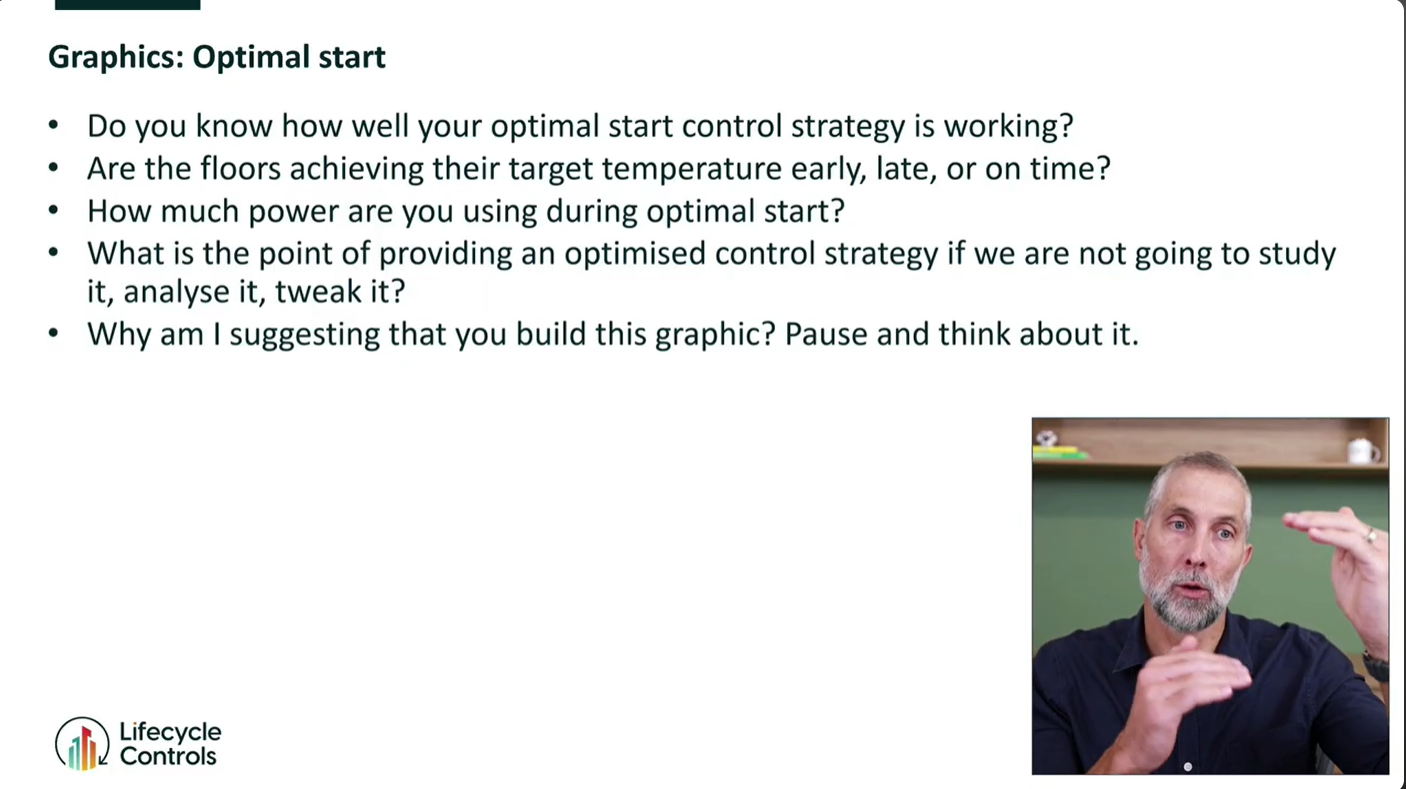
An optimal start control strategy is designed to pre-start the air conditioning a certain amount of time before occupancy to achieve comfortable temperatures at occupancy time. It looks at the outside air temperature, the zone temperature, the occupancy time schedule, and considers what happened the day before. I.e., did we reach the target zone temperature early or late yesterday?
At first glance, that seems like an energy efficiency strategy… But it is not; it is a comfort control strategy. Most out-of-the-box optimal start modules do not at all consider if there is a more efficient way to pre-heat or pre-cool the building.
We need a complete redesign of optimal start. This course will give you many ideas on how to save energy by either tweaking easy fixes or going all in and rebuilding it from the ground up.
Our Building Management System (BMS) training courses expand on the product training provided by BMS companies to develop engineers into professionals who justify repeat work, higher fees, and higher profits.
Self-paced online training course.
Video, audio and text lessons.
Done-for-you Microsoft Word design templates.
One-off payment.
Lifetime access (for as long as the training business exists).
Optimal start is not just a module in a controller, it is a complex system
Optimal start is a building-wide strategy. It is not just a module that pre-starts the air conditioning systems. If you are going to do this properly and reap the rewards, then you need to design the optimal start from the ground up. The VAVs need to switch into Optimal Start mode, and the AHUs and the chillers and the boilers.
This is one of the reasons why Optimal Start operates so poorly; it is an afterthought. We design the main plan systems and terminal unit systems, and then afterwards, just bolt on a basic Optimal Start module to prestart the building. We are not just pre-starting the building; all systems need to switch into a different mode and operate completely differently from normal mode.
“What you do, who you do it with, and how you do it, is more important than how hard you work.
I don’t just teach you the technical stuff; I teach you how to leverage technical concepts to generate real value for you, your company, and the client. ”


Bryce Anderson
For the first 15 years of my career (1998-2013), I worked for BMS companies (2 years in South Africa, 9 years in London, and 4 years in Australia). For the next +10 years (from 2014 onwards), I have worked as a BMS specialist consultant. I originally studied electronic engineering, specialising in process instrumentation and controls.
In my consulting business (80% of my working week), I am designing (writing specifications), reviewing BMS contractor technical submissions, witnessing and signing off BMS projects from all major BMS systems and a wide range of different BMS companies, from global tier-1 manufacturers to smaller system integrators.
This puts me in a unique situation where I have visibility into what everyone is doing. The experience I share in the membership is made up from my own personal 15 years designing BMS systems, writing software code, commissioning, service and project management (across 3 different regions), plus the best parts of what the industry is providing.
This exposure to the wider industry allows me to provide customised training courses that not only teach the technical side of the BMS but also address current real-life issues and constraints in the Building Management System industry.
I am not just teaching you what I learned, but the best of what everyone else is doing.
Testimonials
Course Details
Self-paced online course.
1 hour of audio lessons.
BMS design examples.
AU$ 29 - Australian dollars
Need group training? Contact me to discuss.
Do not leave your career up to your employer
Some people believe their company should pay for their training and allocate time during the working day to do the courses. Let’s unpack this for a minute.
Your company is already paying for your salary, leave pay, sick pay, laptop, mobile phone, car, uniform, and other benefits. They also have other overheads, like office rent, utilities, insurance, administration staff, etc. They pay for other types of non-technical training (health and safety, etc.), AND they pay for product training (5-day programming course, etc.).
I think that is enough. Why should they also pay for your personal professional development? Company managers, feel that you should contribute to your own personal growth, invest in your own career, and I agree.
We work for money. To buy nice things. To live in a nice house. To have nice holidays. It’s up to us, it’s up to YOU, to invest in YOUR career. Why on earth would your employer invest extra time and money, over and above what they are already investing in you, so that you can double your salary? YOU need to invest in your career to double your salary.
What this course is NOT
This is NOT a software programming course. You need to take programming courses provided by the manufacturer of the products your company uses. There are many different BMS systems worldwide, and more are entering the market each year. It is impractical for me to try to teach you how to code in 20 different languages and keep up with updates, new revisions, firmware, and features. (I was only trained on about 4 products when I was on the tools).
I will teach you how to design an advanced optimal start control strategy (what we currently offer is embarrassing), but I am not going to teach you how to convert the design you learn from me into software code. Believe me, the coding part is the easy part.
This course is not associated with any BMS product or company.

BMS Companies generally teach their engineers how to use the engineering tools. How to write software code, build database, and create graphics, etc.
It’s not 1995, product training alone is no longer enough.
We need to raise the profile of BMS companies and their engineers.
Our training courses expand on the basic product training provided by companies to develop engineers into professionals that justify repeat work, higher fees, and higher profits.